
Every year, the federal government provides billions of dollars in grant funding to nonprofits, institutions, and state and local governments. The primary gateway to this funding is through the Notice of Funding Opportunity or NOFO, which is the public announcement of each grants’ details, requirements, and objectives for the funding.
Legacy announcements are dense, long, and hard to make sense of. For most organizations, applying for federal grants is an overly complex and resource-intensive effort. This leaves a lot of smaller and lower-resourced organizations out of the running, even if they’re well qualified.
As the largest grant-making agency (distributing ~$90B annually), HHS partnered with the Lab at OPM to simplify grant announcements in order to create greater competition and more equitable grant distribution.
The initial engagement was for a 3-month research sprint to develop recommendations for design improvement, focused on readability, length, and visual layout. Based on our strong insights and strategic expertise, HHS extended to a second phase of work to put our learnings into action, with a pilot release and evaluation of 4 redesigned announcements.
Discovery Research: With a short timeline, my co-lead and I developed a brief research plan, objectives and discussion guides to organize who to speak with and what we most hoped to learn. We interviewed HHS program offices, subject matter experts, and former grant applicants to better understand the constraints, challenges, and processes that organizations faced when applying to federal grants.
Co-design Workshop: Based on our research insights, I designed and facilitated an interactive workshop with HHS stakeholders using simple visual mockups, clear CX objectives, and open prompts to spark thinking, encourage ideas and conversation, and build alignment around potential improvements.
Strategic Guidance: To achieve the scale of impact HHS was hoping to achieve, it was critical to help their leadership understand that innovation meant more than just visual design changes. By elevating the applicant voice, documenting the ecosystem of challenges for both frontend and backend users, and leveraging service design best practices, I successfully advocated for a more holistic approach to change.

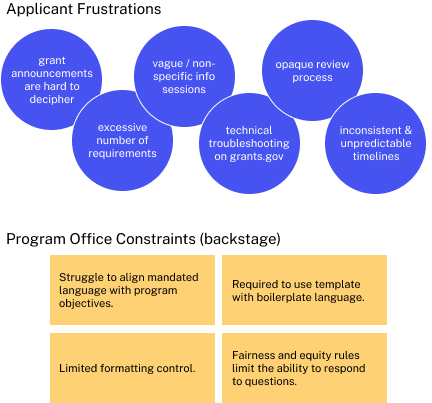
HHS proposed to redesign four upcoming grant announcements based on our phase 1 insights and mock ups to launch publicly and evaluate the results from real applicants.
Prototype Design: I collaborated with the Administration for Children and Families (ACF) and a copywriter to completely rewrite and redesign a grant announcement aimed to support youth in foster care. We made changes to language, tone, layout, and structure in order to make the announcement more accessible, easier to navigate, and ensure applicants didn't miss key requirements.
Stakeholder Management: Competing short term goals and pressures across our HHS stakeholders led to multiple disagreements on what changes we made. I played an essential role as facilitator and peacekeeper to help bridge disagreements and find consensus for the group based on shared objectives and creative solutions.
Evaluation: Our team supported HHS through a multi-part evaluation process, with over 400 applicants providing feedback through surveys, interviews, and small group sessions.
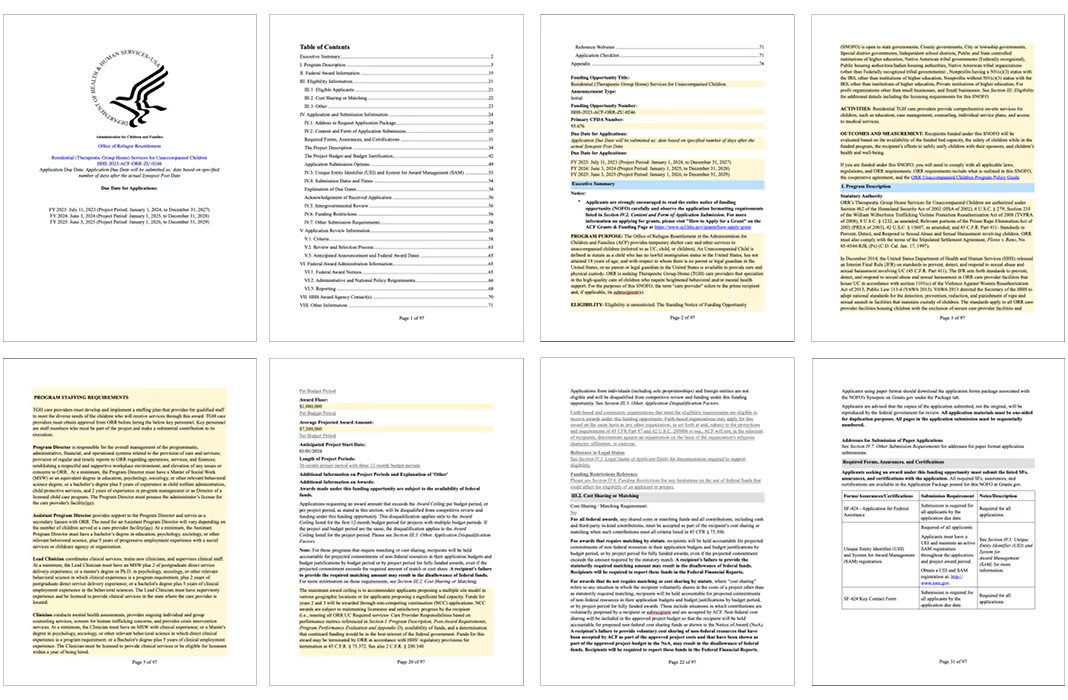
Before: The typical format for HHS grant announcements was long, dense, and highly technical, often with repetitive and inconsistent information across the full document.
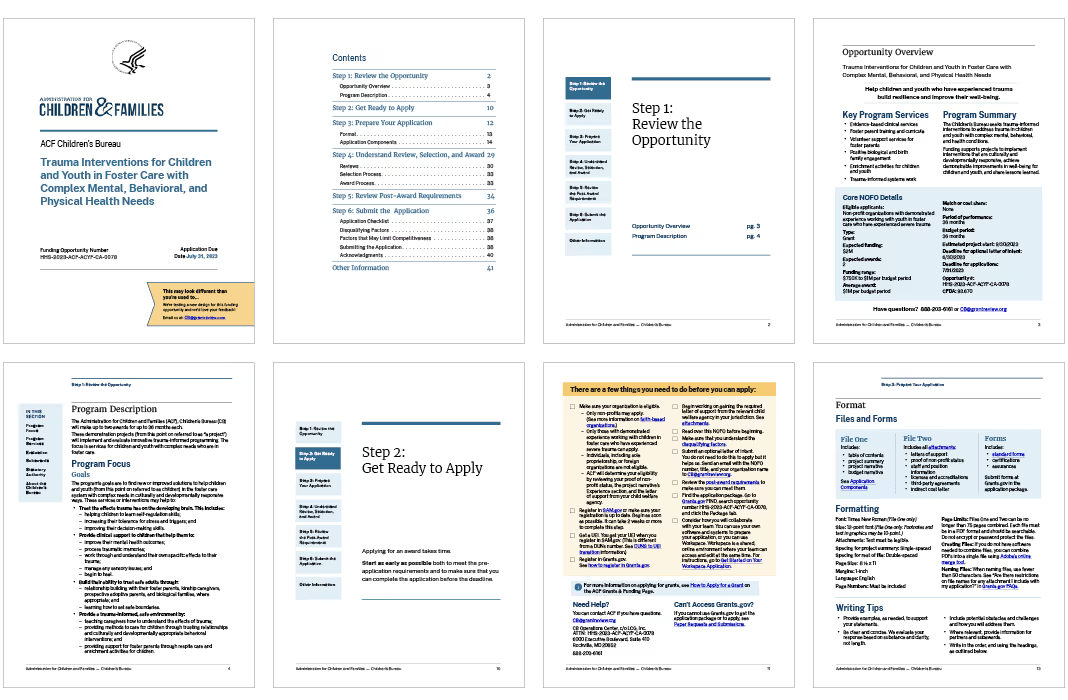
After: The prototype we developed for ACF incorporated shorter, simpler language; a re-organized structure into guiding steps; improved content hierarchy; and checklists and workaround tools borrowed from successful applicants.
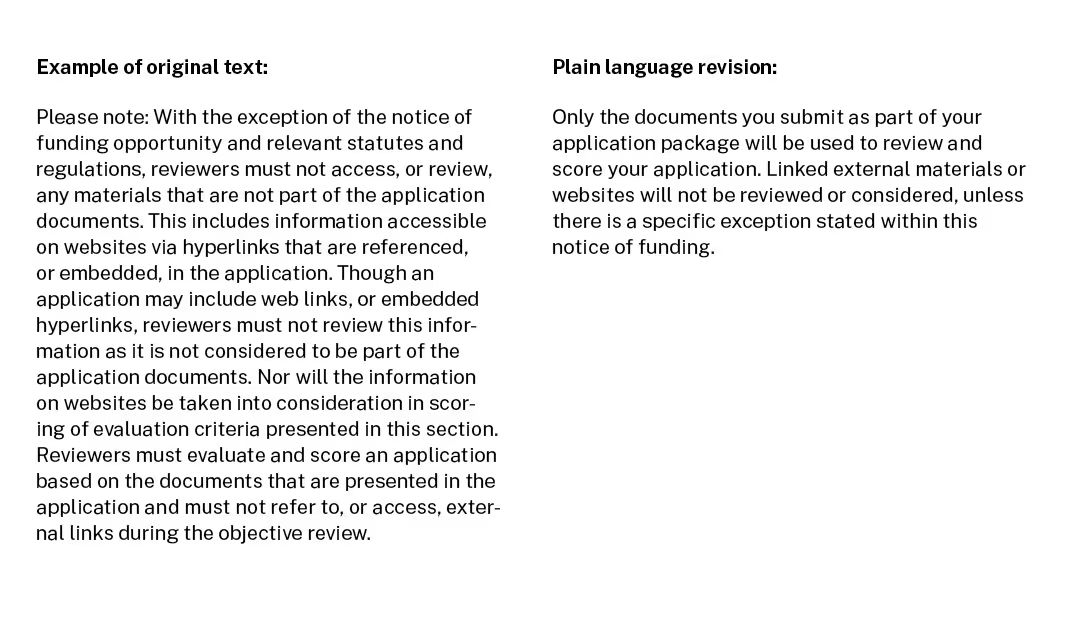
By teaching our partner team at ACF about plain language, it helped not only reduce the overall length of the announcement but demonstrated how simpler, direct language is easier to understand and leads to less mistakes by applicants.
Our pilot evaluation revealed a 31% reduction in time required to prepare applications, along with clear improvements in clarity, usability, and information hierarchy. My prototype directly informed the agency-wide grant announcement template now being scaled across HHS.
Beyond the deliverables, my systems-thinking approach helped shift partner mindsets—growing design maturity and unlocking additional funding to support continued improvement and scale.
Our work built the foundation for scaling design improvements to hundreds of federal grants across the federal sector.
“This NOFO was everything to me – we called it the bible. I love the fact that this one was broken down into sections. With most RFPs it’s so technical you have to pull out the language and figure out where to start."
– Applicant feedback on ACF prototype
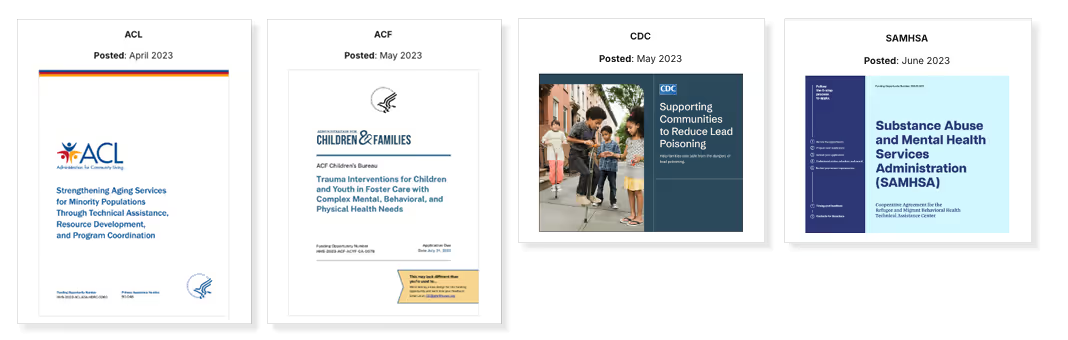
4 published prototype announcements. See more at: simplergrants.hhs.gov
As the largest provider of federal grants HHS has an immense role in how federal funding gets distributed. By leading with transparency, documenting their efforts online, and taking an agile, collaborative approach, this work could revolutionize how federal grants are awarded.
The Lab’s role in the early parts of this initiative established a solid foundation built around human-centered design values. Our influence led HHS to appreciate that it could test, refine, and deliver a better product by inviting feedback before designing a new, final notice.
“The Lab team has been critical in laying the foundation for our simplified NOFOs at HHS and evaluating our success”
– HHS Partner lead, Customer Satisfaction Survey
Check out how this work continues: simplergrants.hhs.gov
Lab at OPM
Co-lead, Design Research: Arielle McInnes-Simoncelli
Co-lead, Design Strategy: Kelly Bryan
(phase 2) Design Researcher: Erika Lindsey
(phase 2) Visual Designer: Dory Pogers
HHS Office of Grants
Project Lead: Elizabeth Overstreet
Project Manager: Julie Wiegandt
(phase 2) Copywriter:
(phase 2) Design Strategist: Emily Ianacone
